
When you entered the front foyer of the old Cherokee Indian Hospital Authority, affixed to the stone wall was a large placard that displayed what is now one of the organization’s Guiding Principles, “ᏂᎯᏣᏤᎵ.” It was mounted to commemorate the Eastern Band of Cherokee Indians assuming responsibility for the administration of the healthcare system in 2002.
September 9, 2026, marks the 24th anniversary of a defining moment in the modern history of health care for the Eastern Band of Cherokee Indians.
On September 9, 2002, Tribal Council amended and passed Ordinance No. 410, formally establishing Cherokee Indian Hospital Authority as an entity of the Eastern Band of Cherokee Indians. Through this action, the EBCI exercised its right to self-determination by assuming responsibility for the administration of Cherokee Indian Hospital and the health care of its people.
The ordinance followed years of discussion, planning, and a growing belief that the Eastern Band could create a stronger health system by placing decisions closer to the community.
Before 2002, Cherokee Indian Hospital Authority and most health services on the Qualla Boundary were administered by the federal Indian Health Service. Although hospital employees were deeply committed to their patients, federal funding limitations and administrative requirements often restricted their ability to respond to local needs. Establishing formal agreements with neighboring health care providers could be difficult, and insufficient funding sometimes limited access to needed services.
By the late 1990s, Tribal leaders and health care professionals had begun exploring a different path. They believed the EBCI had the knowledge, leadership and capacity to manage its own health system and make decisions guided by the needs of Cherokee people.
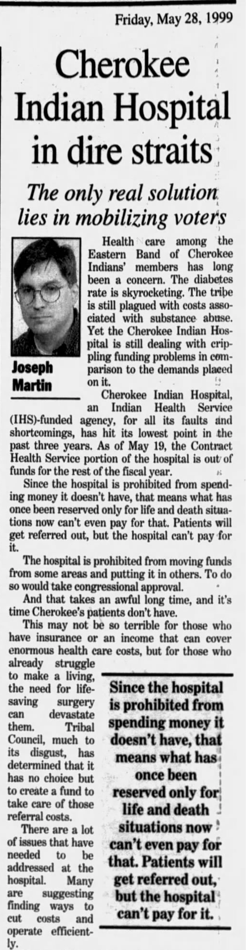
The need for change became increasingly urgent when proposed Indian Health Service (IHS) budget reductions threatened important services. Those reductions could have affected inpatient care, pharmacy funding and the resources used to connect patients with specialty care outside Cherokee. An article in the Asheville Citizens Times in May 1999 featured the headline “Cherokee Indian Hospital in dire straits.” At that time, the hospital was funded entirely by the Indian Health Service and reported that as of May 19 of that year, the Contract Health Service portion of the hospital was completely out of funds for the rest of the fiscal year. At that time, IHS was only funding services at CIHA at about $1,000 per head and the average surgery could cost anywhere from 3 to 100 times that. At the same time that IHS didn’t have enough funds to finish funding facilities in 1999, and demand on the system was increasing, Congress was in budget negotiations and were looking at slashing the already miniscule IHS budget by 15%.
Rather than accept the possibility of fewer services for the community, the EBCI chose to assume greater responsibility for its health care system.
The transition was made possible through the Indian Self-Determination and Education Assistance Act, a federal law that allows federally recognized Tribes to administer programs that would otherwise be operated by the federal government. The federal government’s trust responsibility for Tribal health care did not end. Instead, authority over how programs and resources were managed shifted closer to the people they were intended to serve. Former Chief Leon Jones wrote a commentary for the Asheville Citizens Times in May 2002 praising the progress made possible for the Eastern Band of Cherokee Indians through self-determination, which was being threatened by the courts. “The Eastern Band of Cherokee has proven what we can do when given the tools to control our own destiny.” EBCI Chief Leon Jones said in May 2002, just a few months before the Tribe assumed control of the Cherokee Indian Hospital Authority. The progress he wrote about was the momentum Tribal leaders needed to add healthcare to the list of things they took control of.
On September 2, 2002, the EBCI assumed responsibility for Cherokee Indian Hospital Authority through a self-governance compact with Indian Health Service. One week later, Ordinance No. 410 established CIHA and gave the new Tribal entity the authority to determine how its programs, services, functions, and activities would be administered.
More than just a change in management from the Federal government to the Cherokee People, this decision was an exercise of Tribal sovereignty and an affirmation that Cherokee people should have a direct role in determining what health and healing look like for their community.
The vision of Tribal leaders in 2002 laid the foundation for more than two decades of growth. Over the last 24 years, CIHA has expanded services, strengthened partnerships and developed a health care system intentionally reliant on relationships, culture and community priorities. The progress came quick. By 2004, instead of debating which services to cut to finish the fiscal year, CIHA had opened a new emergency department and a new expanded outpatient clinic.
That growth continued and by 2015, included the opening of a brand new 155,000 square foot facility, which continues to house the organization today. The continuum of care continued when CIHA established Analenisgi and expanded behavioral health and residential treatment services, developed a network of satellite clinics to serve enrolled members who live off the boundary, and continued with the creation of the first-in-the-nation Indian Managed Care Entity in EBCI Tribal Option and a state-of-the-art long-term care facility in Tsali Care Center.
Each of these milestones can be traced to the belief at the heart of self-determination, the people closest to a community are best positioned to understand its needs and shape its future.
“As we recognize this anniversary, we honor the courage and vision of the Tribal leaders, health care professionals and community members who believed the Eastern Band of Cherokee Indians could build a better health care system for its people,” said CIHA Chief Executive Officer Casey Cooper. “That decision laid the foundation for the organization we are today, and I am grateful to every employee who carries this legacy forward through their service to our patients, families and community.”
Twenty-four years later, CIHA continues to build upon the responsibility entrusted to it. The organization has grown far beyond the walls of a hospital, but its purpose remains focused on the same commitment that guided the decision in 2002; to preserve services, strengthen the health of the community and to ensure the voices of Cherokee people are at the forefront of the care they receive today, to protect that care for the next seven generations.